Evaluation of radial distortion with triangulation
Author: Yannick Copin y.copin@ipnl.in2p3.fr
Abstract: The radial distortion tends to alter more the positions in the outer part of the field, while it has little impact close to the center of distortion. Triangulation of distorted positions generated from a regular grid can be used to estimate the center of distortion, as well as undistorted step and rotation angle.
In [1]:
import numpy as N
import scipy as S
import matplotlib.pyplot as P
%matplotlib inline
Create a distorted grid
In [2]:
def create_grid(nx, ny, scale=1., rotation=0.):
    """Create a (npts, 2) array of coordinates."""

    x = N.arange(nx) - (nx-1)/2.
    y = N.arange(ny) - (ny-1)/2.
    xy = N.array(N.meshgrid(x, y)).T.reshape(-1, 2).astype(float)  # npts × [x, y]
    xy *= scale
    if rotation:
        # Convert to complex and rotate
        xy = (xy[:, 0] + 1j * xy[:, 1]) * N.exp(1j*rotation)
        xy = N.vstack((xy.real, xy.imag)).T  # npts × [x, y]

    return xy
Undistorted positions:
In [3]:
nx, ny = 20, 15
scale = 2
rotation = N.deg2rad(5.)

_xy = create_grid(nx, ny, scale=scale, rotation=rotation)  # Undistorted positions npts × [x, y]
print "Nb of points:", len(_xy)
Nb of points: 300
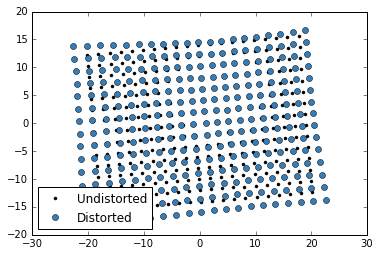
Add r² radial distortion:
In [4]:
xy0 = [3, 5]  # True center of distortion
K1 = 0.005  # Radial distortion r²-coeff
r2 = N.sum((_xy - xy0)**2, axis=1)
t = N.arctan2(_xy[:, 1], _xy[:, 0])
xy = _xy + K1 * N.vstack((r2 * N.cos(t), r2 * N.sin(t))).T  # Distorted positions
In [5]:
P.plot(_xy[:, 0], _xy[:, 1], '.k', label='Undistorted')
P.plot(xy[:, 0], xy[:, 1], 'o', label='Distorted')
P.legend(loc='lower left', numpoints=1)
Out[5]:
<matplotlib.legend.Legend at 0xaf2a962c>
Triangulation
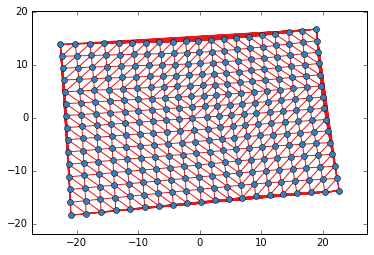
Using scipy.spatial.Delaunay
In [6]:
from scipy.spatial import Delaunay, delaunay_plot_2d
tess = Delaunay(xy)
In [7]:
fig = delaunay_plot_2d(tess) # plot + triplot
`scipy.spatial.Delaunay <http://docs.scipy.org/doc/scipy/reference/generated/scipy.spatial.Delaunay.html>`__
lacks of helper methods/functions to post-process the triangulation. We
rather use
`matplotlib.tri.Triangulation <http://matplotlib.org/api/tri_api.html#matplotlib.tri.Triangulation>`__.
Using matplotlib.tri.Triangulation
In [8]:
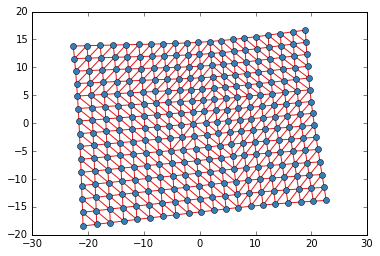
tri = P.matplotlib.tri.Triangulation(xy[:, 0], xy[:, 1])
Remove quasi-degenerate triangles on the borders:
In [9]:
# See http://matplotlib.org/mpl_examples/pylab_examples/tricontour_smooth_delaunay.py
min_circle_ratio = 0.1
mask = P.matplotlib.tri.TriAnalyzer(tri).get_flat_tri_mask(min_circle_ratio)
tri.set_mask(mask)
print("After selection: {} triangles, {} edges".format(tri.triangles.shape[0], tri.edges.shape[0]))
After selection: 594 triangles, 831 edges
In [10]:
P.plot(xy[:, 0], xy[:, 1], 'o')
P.triplot(tri);
Triangulation analysis
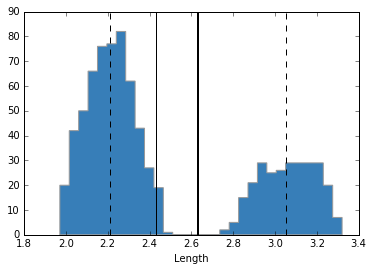
Compute length of all (selected) edges:
In [11]:
edges = xy[tri.edges]  # nedges × [start, end] × [x, y]
dxy = edges[:, 1] - edges[:, 0]  # nedges × [x, y]
lengths = N.sum(dxy**2, axis=1)**0.5  # nedges
In [12]:
P.hist(lengths, bins=30, histtype='stepfilled')

cut = N.percentile(lengths, 66)
P.axvline(cut, c='k')
medinf = N.median(lengths[lengths <= cut])
medsup = N.median(lengths[lengths >= cut])
P.axvline(medinf, c='k', ls='--')
P.axvline(medsup, c='k', ls='--')
med = (medinf + medsup) / 2
P.axvline(med, c='k', lw=2)
P.xlabel("Length");
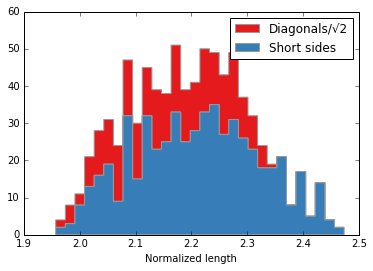
Normalized lengths:
In [13]:
diags = lengths > med  # Diagonals
lengths[diags] /= 2**0.5
In [14]:
P.hist([lengths[~diags], lengths[diags]], bins=30, stacked=True, histtype='stepfilled',
       label=['Short sides', u'Diagonals/√2'])
P.legend(loc='upper right')
P.xlabel("Normalized length");
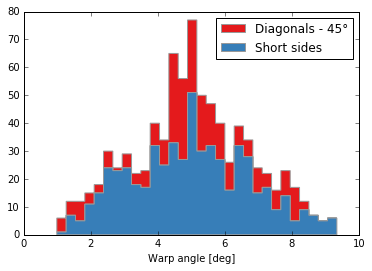
Compute angles (modulo π/4):
In [15]:
angles = N.rad2deg(N.arctan2(dxy[:, 1], dxy[:, 0])) + 180.
angles = (4 * angles - 180 * N.around(4*angles/180)) / 4
In [16]:
P.hist([angles[~diags], angles[diags]], bins=30, stacked=True, histtype='stepfilled',
       label=['Short sides', u'Diagonals - 45°'])
P.legend(loc='upper right')
P.xlabel("Warp angle [deg]");
Sort edges by increasing length:
In [17]:
iedges = N.argsort(lengths)
Compute elements of distortions from smallest edges:
In [18]:
frac_cen = 0.05
ncen = int(len(edges) * frac_cen)
print "Nb of undistorted edges:", ncen
shortests = edges[iedges[:ncen]]   # ncen × [start, end] × [x, y]
xyc = N.mean(shortests, axis=(0, 1))  # Center of distortion
print "Center of distortion:", xyc
length = N.median(lengths[iedges[:ncen]])  # Undistorted step
print "Undistorted step:", length
angle = N.median(angles[iedges[:ncen]])  # Undistorted angle
print "Undistorted angle [deg]:", angle
Nb of undistorted edges: 41
Center of distortion: [ 2.86707356  4.30324354]
Undistorted step: 2.00605382314
Undistorted angle [deg]: 5.03934704597
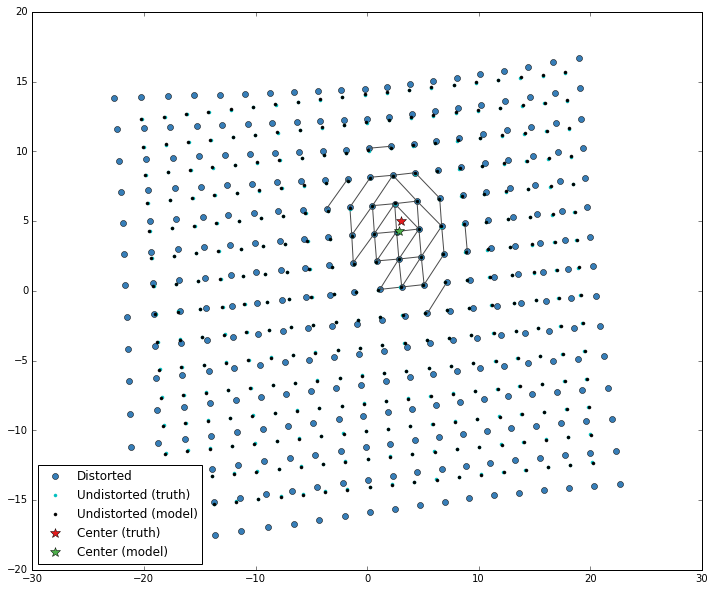
Reference grid
Modeled positions (undistorted):
In [19]:
xyu = create_grid(nx, ny, scale=length, rotation=N.deg2rad(angle)) # Modeled (undistorted) positions
In [20]:
P.plot(xy[:, 0], xy[:, 1], 'o', label='Distorted')
P.plot(shortests[..., 0].T, shortests[..., 1].T, c='0.3')
P.plot(_xy[:, 0], _xy[:, 1], '.c', label='Undistorted (truth)')
P.plot(xyu[:, 0], xyu[:, 1], '.k', label='Undistorted (model)')
P.plot([xy0[0]], [xy0[1]], marker='*', ms=10, ls='none', label='Center (truth)')
P.plot([xyc[0]], [xyc[1]], marker='*', ms=10, ls='none', label='Center (model)')
P.legend(loc='lower left', numpoints=1)
P.gcf().set_size_inches((12, 10))
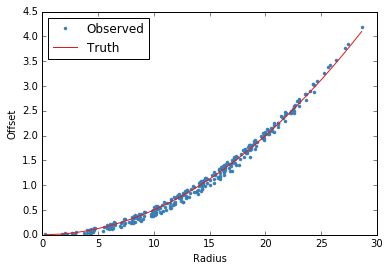
Radial distortion:
In [21]:
ru = N.sum((_xy - xyc)**2, axis=1)**0.5
offsets = xy - xyu  # npts × [x, y]
dr = N.hypot(offsets[:, 0], offsets[:, 1])
In [22]:
P.plot(ru, dr, '.', label='Observed')
sru = N.sort(ru)
P.plot(sru, K1 * sru**2, marker='', ls='-', label='Truth')
P.xlabel("Radius")
P.ylabel("Offset")
P.legend(loc='upper left', numpoints=1);
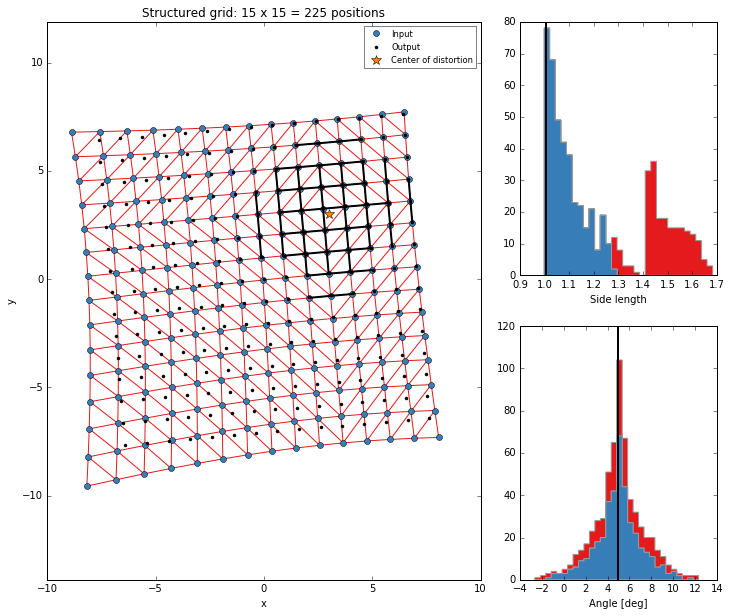
spectrogrism.distortion implementation
The aforementioned procedure is implemented in the
spectrogrism.distortion module. The rescaling of long edges is not
trustworthy, and is not applied.
In [23]:
from spectrogrism import distortion as SD
In [24]:
grid = SD.StructuredGrid.create(15, 15, scale=1, rotation=N.deg2rad(5.))
print(grid)

# Add distortions
gdist = SD.GeometricDistortion(3 + 4j,
                               Kcoeffs=[1e-3], Pcoeffs=[1e-3, 0, 1e-3])
print(gdist)

grid.xy = gdist.forward(grid.xy)

fig = P.figure()
length, angle, offset, center = grid.model_parameters(fig=fig)
fig.set_size_inches((12, 10))
Structured grid: 15 x 15 = 225 positions
Geometric distortion: center=(+3, +4), K-coeffs=[ 0.001], P-coeffs=[ 0.001  0.     0.001]