Distortion analyses in NISP simulations
Author: Yannick Copin y.copin@ipnl.in2p3.fr
In [1]:
%matplotlib inline

# try:
#     import mpld3  # Interactive plots
#     mpld3.enable_notebook()
# except ImportError:
#     pass

try:
    import seaborn
    seaborn.set_style('ticks', {"axes.grid": True})
except ImportError:
    pass

import warnings
warnings.filterwarnings("ignore")
In [2]:
import numpy as N
from matplotlib import pyplot as P
from spectrogrism import spectrogrism as S
from spectrogrism import nisp
from spectrogrism import distortion as D
In [3]:
datapath = "../spectrogrism/data/"
simulations = S.Configuration([
    ("name", "Zemax"),
    (1, datapath + "run_190315.dat"),            # 1st-order dispersed simulation
    (0, datapath + "run_011115_conf2_o0.dat"),   # 0th-order dispersed simulation
    (2, datapath + "run_161115_conf2_o2.dat"),   # 2nd-order dispersed simulation
    ('J', datapath + "run_071215_conf6_J.dat"),  # J-band undispersed simulation
])
zmx = nisp.ZemaxPositions(simulations)
print(zmx)
Simulations 'Zemax': 4 modes
  Order #1: ../spectrogrism/data/run_190315.dat
  Order #0: ../spectrogrism/data/run_011115_conf2_o0.dat
  Order #2: ../spectrogrism/data/run_161115_conf2_o2.dat
  Band   J: ../spectrogrism/data/run_071215_conf6_J.dat
  Wavelengths: 13 steps from 1.20 to 1.80 µm
  Coords: 289 sources
Photometric modes
Band J
In [4]:
df = zmx['J']
df.info()
<class 'pandas.core.frame.DataFrame'>
Float64Index: 13 entries, 1.2e-06 to 1.8e-06
Columns: 289 entries, (-0.006981317008-0.006981317008j) to (0.006981317008+0.006981317008j)
dtypes: complex128(289)
memory usage: 58.8 KB
Restructure mean position (averaged over wavelengths) into an ad-hoc structured grid:
In [5]:
xy = df.mean(axis=0).values  # Mean (complex) positions (averaged over wavelengths) (289,)
xy = xy.reshape(-1, 17)      # (17, 17)
grid = D.StructuredGrid(xy)
print(grid)
Structured grid: 17 x 17 = 289 positions, y-x-
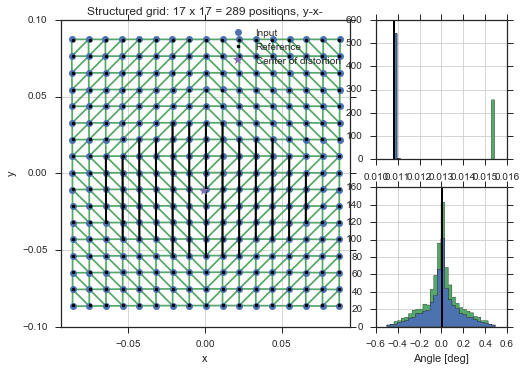
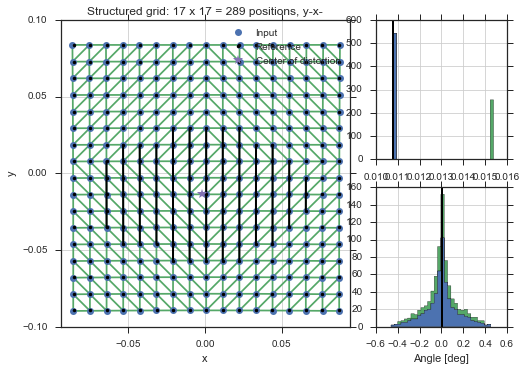
Estimate effective undistorted grid properties (step, rotation, minimal distortion position) from triangulation analysis (no optical modeling):
In [6]:
step, angle, offset, center = grid.estimate_parameters(fig=True)
print(u"Offset: ({0.real:.3f}, {0.imag:.3f}), step: {1:.3f}, angle: {2:.1f}°"
     .format(offset, step, N.rad2deg(angle)))
print(u"Center of distortion: ({0.real:.3f}, {0.imag:.3f})".format(center))
Offset: (0.001, 0.000), step: 0.011, angle: 0.0°
Center of distortion: (-0.001, -0.012)
Construct effective undistorted grid used as reference:
In [7]:
refgrid = D.StructuredGrid.create(grid.nx, grid.ny, step=step, rotation=angle, offset=offset)
refgrid.reorder(grid.signature)
print(refgrid)
Structured grid: 17 x 17 = 289 positions, y-x-
Compute offset RMS between observed distorted (grid) and reference
undistorted (refgrid) grids:
In [8]:
rms = grid.rms(refgrid.xy)
print("RMS = {:.3g} mm = {:.3g} px".format(rms / 1e-3, rms / 18e-6))

ax = grid.plot_offsets(refgrid, units=(18e-6, 'px'))
ax.figure.suptitle("Distortion wrt. ref. grid");
RMS = 0.313 mm = 17.4 px
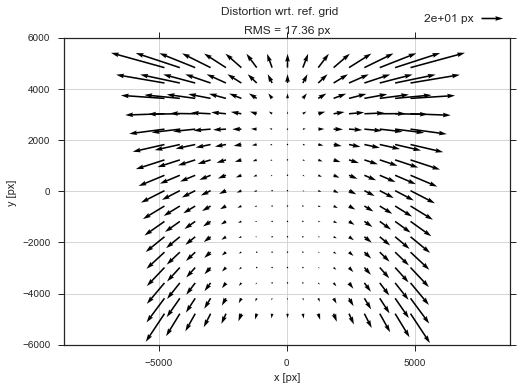
It is already apparent that the distortion will not be well approximated by a radial expansion. This is an hint of off-axis optics.
In [9]:
dxy = grid.xy - refgrid.xy
r = N.abs(grid.xy - center).ravel()
dr = N.hypot(dxy.real, dxy.imag).ravel()

fig, ax = P.subplots(subplot_kw={'title': "Radial distortion wrt. reference grid",
                                 'xlabel': "r [mm]", 'ylabel': "dr [mm]"})
ax.plot(r / 1e-3, dr / 1e-3, '.');
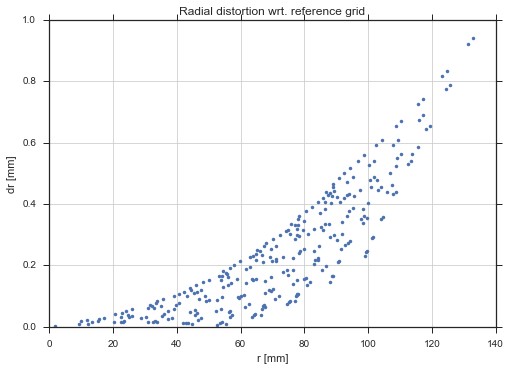
Adjust the distortion with a simple r² radial expansion:
In [10]:
dist = D.GeometricDistortion(center, Kcoeffs=[0.], Pcoeffs=[])
print(dist)
Geometric distortion: center=(-0.000581568, -0.0117205), K-coeffs=[ 0.], P-coeffs=[]
In [11]:
minuit = refgrid.adjust_distortion(grid, dist, scale=True, offset=True)

minuit.print_matrix()
adjrms = minuit.fval ** 0.5  # objfun is RMS**2
print("RMS = {:.4f} mm = {:.2f} px".format(adjrms / 1e-3, adjrms / 18e-6))
| FCN = 2.95884139728e-08 | TOTAL NCALL = 81 | NCALLS = 81 |
| EDM = 3.52836930647e-08 | GOAL EDM = 1e-05 | UP = 1.0 |
| Valid | Valid Param | Accurate Covar | PosDef | Made PosDef |
| True | True | True | True | False |
| Hesse Fail | HasCov | Above EDM | Reach calllim | |
| False | True | False | False |
| + | Name | Value | Parab Error | Minos Error- | Minos Error+ | Limit- | Limit+ | FIXED |
| 1 | x0 | -0.000581568 | 3066.74 | 0 | 0 | |||
| 2 | y0 | -0.0117205 | 440.968 | 0 | 0 | |||
| 3 | K1 | 0.197522 | 15443.2 | 0 | 0 | |||
| 4 | scale | 1.00178 | 120.952 | 0 | 0 | |||
| 5 | dx | 2.23496e-06 | 7.18037 | 0 | 0 | |||
| 6 | dy | -2.67727e-05 | 1.92654 | 0 | 0 |
| + |
x0
|
y0
|
K1
|
scale
|
dx
|
dy
|
| x0 | 1.00 | -0.62 | -0.96 | 0.95 | 0.99 | 0.73 |
| y0 | -0.62 | 1.00 | 0.65 | -0.63 | -0.61 | -0.19 |
| K1 | -0.96 | 0.65 | 1.00 | -0.99 | -0.95 | -0.76 |
| scale | 0.95 | -0.63 | -0.99 | 1.00 | 0.94 | 0.76 |
| dx | 0.99 | -0.61 | -0.95 | 0.94 | 1.00 | 0.72 |
| dy | 0.73 | -0.19 | -0.76 | 0.76 | 0.72 | 1.00 |
RMS = 0.1720 mm = 9.56 px
Reconstruct adjusted distorted grid from fit parameters:
In [12]:
adjdist = D.GeometricDistortion.from_kwargs(**minuit.values)
adjgrid = D.StructuredGrid(adjdist.forward(refgrid.xy))

ax = grid.plot_offsets(adjgrid, units=(18e-6, 'px'))
ax.figure.suptitle("Distortion wrt. adjusted grid");
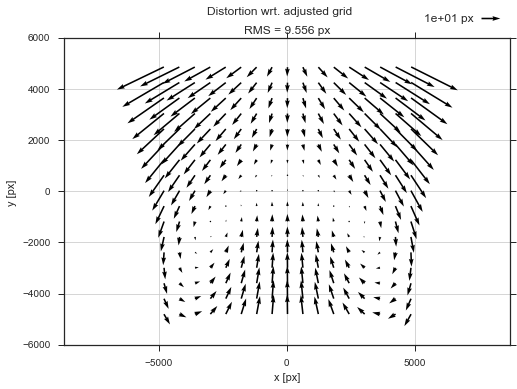
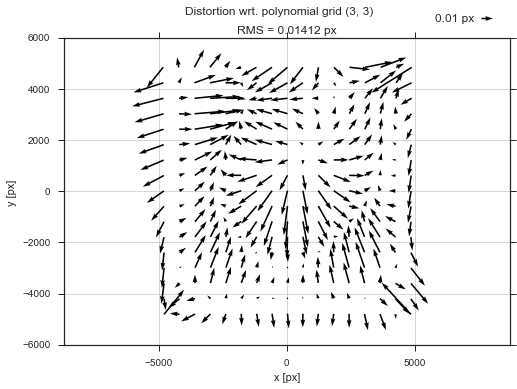
Given the fact that the off-axis distortion pattern will not be well approximated by a radial expansion, one can test a generic polynomial expansion:
In [13]:
from spectrogrism import polyfit

poldeg = (3, 3)
print("Total number of coeff.: {}".format((poldeg[0] + 1) * (poldeg[1] + 1)))
px = polyfit.fit_legendre2D(refgrid.x, refgrid.y, dxy.real.ravel(), deg=poldeg)
py = polyfit.fit_legendre2D(refgrid.x, refgrid.y, dxy.imag.ravel(), deg=poldeg)
Total number of coeff.: 16
In [14]:
polygrid = D.StructuredGrid(refgrid.xy +
                            px(refgrid.xy.real, refgrid.xy.imag) +
                            py(refgrid.xy.real, refgrid.xy.imag) * 1j)

ax = grid.plot_offsets(polygrid, units=(18e-6, 'px'))
ax.figure.suptitle("Distortion wrt. polynomial grid {}".format(poldeg));
Spectroscopic modes
Order 1
In [15]:
df = zmx[1]
grid = D.StructuredGrid(df.mean(axis=0).values.reshape(-1, 17))

step, angle, offset, center = grid.estimate_parameters(fig=True)
print(u"Offset: ({0.real:.3f}, {0.imag:.3f}), scale: {1:.3f}, angle: {2:.1f}°"
     .format(offset, step, N.rad2deg(angle)))
print(u"Center of distortion: ({0.real:.3f}, {0.imag:.3f})".format(center))
Offset: (0.001, -0.003), scale: 0.011, angle: 0.0°
Center of distortion: (-0.002, -0.014)
In [16]:
refgrid = D.StructuredGrid.create(grid.nx, grid.ny, step=step, rotation=angle, offset=offset)
refgrid.reorder(grid.signature)  # Reference (undistorted) grid

rms = grid.rms(refgrid.xy)
print("RMS = {:.3g} mm = {:.3g} px".format(rms / 1e-3, rms / 18e-6))

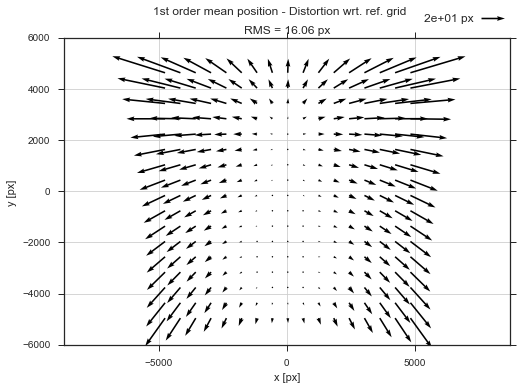
ax = grid.plot_offsets(refgrid, units=(18e-6, 'px'))
ax.figure.suptitle("1st order mean position - Distortion wrt. ref. grid");
RMS = 0.289 mm = 16.1 px
In [17]:
dist = D.GeometricDistortion(center, Kcoeffs=[0.])
minuit = refgrid.adjust_distortion(grid, dist, scale=True, offset=True, print_level=2)

adjdist = D.GeometricDistortion.from_kwargs(**minuit.values)
adjgrid = D.StructuredGrid(adjdist.forward(refgrid.xy))

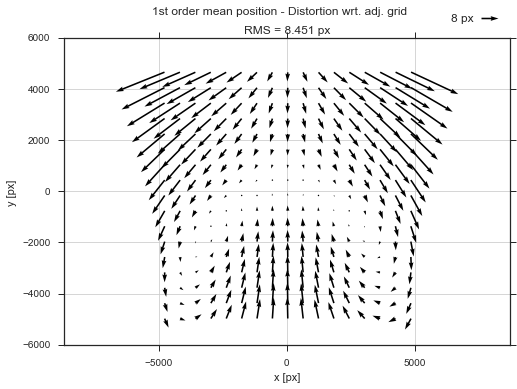
ax = grid.plot_offsets(adjgrid, units=(18e-6, 'px'))
ax.figure.suptitle("1st order mean position - Distortion wrt. adj. grid");
| + | Name | Value | Parab Error | Minos Error- | Minos Error+ | Limit- | Limit+ | FIXED |
| 1 | x0 | -0.00228121 | 0.0074834 | 0 | 0 | |||
| 2 | y0 | -0.0137074 | 0.0074834 | 0 | 0 | |||
| 3 | K1 | 0 | 0.001 | 0 | 0 | |||
| 4 | scale | 1 | 0.01 | 0 | 0 | |||
| 5 | dx | 0 | 0.000289115 | 0 | 0 | |||
| 6 | dy | 0 | 0.000289115 | 0 | 0 |
| FCN = 2.31410845187e-08 | TOTAL NCALL = 83 | NCALLS = 83 |
| EDM = 6.54738621888e-09 | GOAL EDM = 1e-05 | UP = 1.0 |
| Valid | Valid Param | Accurate Covar | PosDef | Made PosDef |
| True | True | True | True | False |
| Hesse Fail | HasCov | Above EDM | Reach calllim | |
| False | True | False | False |
| + | Name | Value | Parab Error | Minos Error- | Minos Error+ | Limit- | Limit+ | FIXED |
| 1 | x0 | -0.00228121 | 1160.23 | 0 | 0 | |||
| 2 | y0 | -0.0137074 | 360.647 | 0 | 0 | |||
| 3 | K1 | 0.189796 | 5916.25 | 0 | 0 | |||
| 4 | scale | 1.00167 | 49.9196 | 0 | 0 | |||
| 5 | dx | 4.83733e-06 | 2.81307 | 0 | 0 | |||
| 6 | dy | -2.22931e-05 | 1.53002 | 0 | 0 |
Order 0
In [18]:
df0 = zmx[0]
grid0 = D.StructuredGrid(df0.mean(axis=0).values.reshape(-1, 17))  # Observed grid

step, angle, offset, center = grid0.estimate_parameters()  # Initial parameters
refgrid0 = D.StructuredGrid.create(grid0.nx, grid0.ny, step=step, rotation=angle, offset=offset)
refgrid0.reorder(grid0.signature)  # Reference (undistorted) grid

# Adjust minimal mapping: scale + offset
dist0 = D.GeometricDistortion()
minuit0 = refgrid0.adjust_distortion(grid0, dist0, scale=True, offset=True, print_level=2)

adjdist0 = D.GeometricDistortion.from_kwargs(**minuit.values)
adjgrid0 = D.StructuredGrid(adjdist0.forward(refgrid0.xy))  # Adjusted (distorted) grid

rms = grid0.rms(adjgrid0.xy)
print("RMS = {:.3g} mm = {:.3g} px".format(rms / 1e-3, rms / 18e-6))

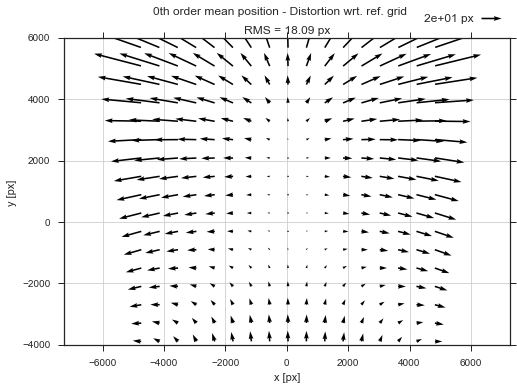
ax = grid0.plot_offsets(adjgrid0, units=(18e-6, 'px'))
ax.figure.suptitle("0th order mean position - Distortion wrt. ref. grid");
| + | Name | Value | Parab Error | Minos Error- | Minos Error+ | Limit- | Limit+ | FIXED |
| 1 | x0 | 0 | 0.00760277 | 0 | 0 | |||
| 2 | y0 | 0 | 0.00760277 | 0 | 0 | |||
| 3 | scale | 1 | 0.01 | 0 | 0 | |||
| 4 | dx | 0 | 0.000564474 | 0 | 0 | |||
| 5 | dy | 0 | 0.000564474 | 0 | 0 |
| FCN = 8.25932987863e-08 | TOTAL NCALL = 64 | NCALLS = 64 |
| EDM = 5.46896901308e-09 | GOAL EDM = 1e-05 | UP = 1.0 |
| Valid | Valid Param | Accurate Covar | PosDef | Made PosDef |
| True | True | True | True | False |
| Hesse Fail | HasCov | Above EDM | Reach calllim | |
| False | True | False | False |
| + | Name | Value | Parab Error | Minos Error- | Minos Error+ | Limit- | Limit+ | FIXED |
| 1 | x0 | 0 | 2 | 0 | 0 | |||
| 2 | y0 | 0 | 2 | 0 | 0 | |||
| 3 | scale | 1.00589 | 1.97807 | 0 | 0 | |||
| 4 | dx | 5.84e-06 | 0.894428 | 0 | 0 | |||
| 5 | dy | 0.000116242 | 0.894786 | 0 | 0 |
RMS = 0.326 mm = 18.1 px
In [ ]: