spectrogrism
Generic utilities for modeling grism-based spectrograph.
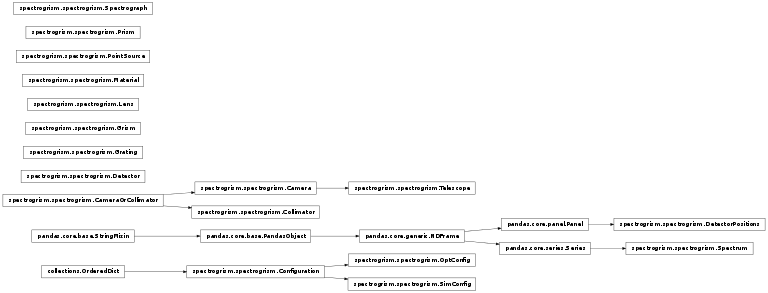
Configuration(adict) |
A OrderedDict-derived configuration. |
OptConfig(adict) |
Optical configuration. |
SimConfig(adict) |
Simulation configuration. |
Spectrum(wavelengths, fluxes[, name]) |
A wavelength-indexed pandas.Series. |
PointSource(coords[, spectrum]) |
A Spectrum associated to a complex 2D-position or direction. |
DetectorPositions(wavelengths, coordinates) |
A container for complex 2D-positions on the detector. |
Material(name) |
Optical material. |
Lens(gamma[, gdist, cdist]) |
Convert a 2D-position into a 2D-position. |
CameraOrCollimator(flength[, gdist, cdist]) |
An optical element converting to and fro directions and positions. |
Collimator(config) |
Convert a 2D-position (in the focal plane) into a 2D-direction. |
Camera(config) |
Convert a 2D-direction into a 2D-position (in the detector plane). |
Telescope(config) |
All-reflective telescope (no chromatic distortions). |
Prism(angle, material[, tilts]) |
A triangular transmissive prism. |
Grating(rho, material[, blaze]) |
A transmissive grating. |
Grism(config) |
A Prism and a Grating on the exit surface. |
Detector(config) |
A simple translated and rotated detector. |
Spectrograph(config[, telescope]) |
A collimated spectrograph. |
-
spectrogrism.spectrogrism.RAD2DEG= 57.29577951308232¶ Convert from radians to degrees
-
spectrogrism.spectrogrism.RAD2MIN= 3437.746770784939¶ Convert from radians to arc minutes
-
spectrogrism.spectrogrism.RAD2SEC= 206264.80624709633¶ Convert from radians to arc seconds
-
class
spectrogrism.spectrogrism.Configuration(adict)[source]¶ A
OrderedDict-derived configuration.override(adict)Override configuration from dictionary adict.save(yamlname)Save configuration to YAML file yamlname.load(yamlname)Load configuration from YAML file yamlname.Initialize from dictionary
adict.-
conftype= 'Configuration'¶ Configuration type
-
-
class
spectrogrism.spectrogrism.OptConfig(adict)[source]¶ Optical configuration.
Initialize from dictionary
adict.-
conftype= 'Optical configuration'
-
wref
-
-
class
spectrogrism.spectrogrism.SimConfig(adict)[source]¶ Simulation configuration.
get_wavelengths(optcfg)Simulated wavelengths. get_coordinates()Simulated input complex coordinates [ x + 1j*y ].Initialize from dictionary
adict.-
conftype= 'Simulation configuration'
-
-
class
spectrogrism.spectrogrism.Spectrum(wavelengths, fluxes, name='spectrum')[source]¶ A wavelength-indexed
pandas.Series.Initialize from wavelength and flux arrays.
Parameters: -
wavelengths¶ Wavelength array.
-
fluxes¶ Fluxes array.
-
-
class
spectrogrism.spectrogrism.PointSource(coords, spectrum=None, **kwargs)[source]¶ A
Spectrumassociated to a complex 2D-position or direction.Initialize from position/direction and spectrum.
Parameters: - coords (complex) – single source (complex) coordinates
- spectrum (Spectrum) – source spectrum (default to standard spectrum)
- kwargs – propagated to
Spectrum.default()constructor
-
coords= None¶ 2D-position/direction
-
class
spectrogrism.spectrogrism.DetectorPositions(wavelengths, coordinates, spectrograph=None, name='default')[source]¶ A container for complex 2D-positions on the detector.
A
pandas.Panel-derived container for (complex) positions in the detector plane:- items are observational modes (dispersion orders or photometric bands)
- major axis is wavelength (shared among all modes)
- minor axis is input complex coordinates (shared among all modes)
For each mode, the corresponding
pandas.DataFrameis therefore organized the following way:zin_1 zin_2 ... zin_N lbda1 zout_1_1 zout_2_1 ... zout_N_1 lbda2 zout_1_2 zout_2_2 ... zout_N_2 ... lbdaM zout_1_M zout_2_M ... zout_N_M
self.modesreturns the available observing modes;df = self.panel[mode]is the dataframe corresponding to a given observingmode;self.wavelengthsreturns wavelength array[lbdas];self.coordinatesreturns (complex) input coordinate array[zins];df[zin]returns a wavelength-indexedpandas.Seriesof complex detector positions.
Warning
Indexing by float is not precisely a good idea... Float indices (wavelengths and input coordinates) are therefore rounded first with a sufficient precision (e.g. nm for wavelengths).
Todo
do not use complex coordinates as column name (this is not natively supported in Pandas, nor a good idea). Store input coordinates in an associated
pandas.Series, and use series index as column names.add_mode(mode, dataframe)Add dataframe as observational mode to current panel. plot([ax, coords, modes, blaze, subsampling])Plot spectra on detector plane. check_alignment(other)Check compatibility in wavelengths and positions with other instance. compute_offset(other[, mode])Compute (complex) position offsets to other instance. compute_rms(other[, mode])Compute total RMS distance to other instance. Initialize container from spectrograph and wavelength array.
Parameters: - wavelengths (list) – input wavelengths [m]
- coordinates (list) – input complex coordinates
- spectrograph (Spectrograph) – associated spectrograph (if any)
- name (str) – informative label
-
digits= 12
-
markers= {0: 'D', 1: 'o', 2: 's', 'H': 'o', 'K': 's', 'J': 'D', -1: '.'}
-
spectrograph= None¶ Associated spectrograph
-
name= None¶ Name
-
modes¶ Observational mode list.
-
coordinates¶ Input source (complex) coordinate array.
-
wavelengths¶ Wavelength array.
-
plot(ax=None, coords=None, modes=None, blaze=False, subsampling=1, **kwargs)[source]¶ Plot spectra on detector plane.
Parameters: - ax (matplotlib.pyplot.Axes) – pre-existing axes instance if any
- coords (list) – selection of input coordinates to be plotted
- modes (list) – selection of observing modes to be plotted
- blaze (bool) – encode the blaze function in the marker size
- subsampling (int) – sub-sample coordinates and wavelengths
- kwargs – options propagated to
matplotlib.pyplot.Axes.scatter()
Returns: matplotlib.pyplot.Axes
-
check_alignment(other)[source]¶ Check compatibility in wavelengths and positions with other instance.
Parameters: other (DetectorPositions) – other instance to be compared to Raises: IndexError – incompatible instance
-
compute_offset(other, mode=1)[source]¶ Compute (complex) position offsets to other instance.
Parameters: - other (DetectorPositions) – other instance to be compared to
- mode – observing mode (dispersion order or photometric band)
Returns: (complex) position offsets [m]
Return type: Raises: KeyError – requested mode cannot be found
Warning
selfandotherare supposed to be compatible (seetest_compatibility()).
-
compute_rms(other, mode=1)[source]¶ Compute total RMS distance to other instance.
Parameters: - other (DetectorPositions) – other instance to be tested
- mode – observing mode (dispersion order or photometric band)
Returns: RMS offset [m]
Return type: Raises: KeyError – requested mode cannot be found
Warning
selfandotherare supposed to be compatible (seetest_compatibility()).
-
class
spectrogrism.spectrogrism.Material(name)[source]¶ Optical material.
The refractive index is described by its Sellmeier coefficients.
Reference: Sellmeier equation
index(wavelengths)Compute refractive index from Sellmeier expansion. Initialize material from its name.
Parameters: name (str) – material name (should be in Material.materials)Raises: KeyError – unknown material name -
materials= {'SK5': [0.99146382, 0.495982121, 0.98739392, 0.00522730467, 0.0172733646, 98.3594579], 'F2': [1.34533359, 0.209073176, 0.93735716, 0.00997743871, 0.0470450767, 111.886764], 'FS': [0.6961663, 0.4079426, 0.8974794, 0.004679148, 0.01351206, 97.934], 'UBK7': [1.01237433, 0.258985218, 1.00021628, 0.00588328615, 0.0190239921, 104.079777], 'SF4': [1.61957826, 0.339493189, 1.02566931, 0.0125502104, 0.0533559822, 117.65222], 'SF57': [1.81651371, 0.428893641, 1.07186278, 0.0143704198, 0.0592801172, 121.419942], 'EPR': [0.512479, 0.838483, -0.388459, -0.0112765, 0.0263791, 557.682], 'BK7': [1.03961212, 0.231792344, 1.01046945, 0.00600069867, 0.0200179144, 103.560653], 'null': [0, 0, 0, 0, 0, 0], 'EPB': [0.406836, 1.03517, -0.140328, -0.0247382, 0.0261501, 798.366]}¶ Sellmeier coefficients [B1, B2, B3, C1, C2, C3] of known materials.
-
coeffs= None¶ Sellmeier coefficients
[B1, B2, B3, C1, C2, C3]
-
name= None¶ Name of the material
-
index(wavelengths)[source]¶ Compute refractive index from Sellmeier expansion.
Sellmeier expansion for refractive index:
\[n(\lambda)^2 = 1 + \sum_{i}\frac{B_i\lambda^2}{\lambda^2-C_i}\]with \(\lambda\) in microns.
Parameters: wavelengths (numpy.ndarray) – wavelengths [m] Returns: refractive index
-
-
class
spectrogrism.spectrogrism.Lens(gamma, gdist=None, cdist=None)[source]¶ Convert a 2D-position into a 2D-position.
Initialize the element from its optical parameters.
Parameters: - gamma (float) – transverse ‘grandissement’
- gdist (D.GeometricDistortion) – geometric distortion
- cdist (D.ChromaticDistortion) – chromatic distortion (lateral color)
-
gamma= None¶ Transverse ‘grandissement’
-
gdist= None¶ Geometric distortion
-
cdist= None¶ Chromatic distortion (lateral color)
-
class
spectrogrism.spectrogrism.CameraOrCollimator(flength, gdist=None, cdist=None)[source]¶ An optical element converting to and fro directions and positions.
Initialize the element from its optical parameters.
Parameters: - flength (float) – focal length [m]
- gdist (D.GeometricDistortion) – geometric distortion
- cdist (D.ChromaticDistortion) – chromatic distortion (lateral color)
-
flength= None¶ Focal length [m]
-
gdist= None¶ Geometric distortion
-
cdist= None¶ Chromatic distortion (lateral color)
-
class
spectrogrism.spectrogrism.Collimator(config)[source]¶ Convert a 2D-position (in the focal plane) into a 2D-direction.
forward(positions, wavelengths, gamma)Forward light propagation through the collimator. backward(directions, wavelength, gamma)Backward light propagation through the collimator. Initialize from optical configuration.
Parameters: config (OptConfig) – optical configuration Raises: KeyError – missing configuration key -
forward(positions, wavelengths, gamma)[source]¶ Forward light propagation through the collimator.
where:
- \(z = x + iy\) is the complex position
- D is the
D.GeometricDistortiongeometric distortion - L is the
D.ChromaticDistortionlateral color - \(\gamma\) is the spectrograph magnification (fcam/fcoll)
The geometric distortion is therefore applied on the (flipped) positions.
-
backward(directions, wavelength, gamma)[source]¶ Backward light propagation through the collimator.
See
Collimator.forward()for details.
-
-
class
spectrogrism.spectrogrism.Camera(config)[source]¶ Convert a 2D-direction into a 2D-position (in the detector plane).
Note
the detector coordinate axes are flipped, so that sources remain in the same quadrant in the focal and detector planes.
forward(directions, wavelengths)Forward light propagation through the camera. backward(positions, wavelength)Backward light propagation through the camera. Initialize from optical configuration.
Parameters: config (OptConfig) – optical configuration Raises: KeyError – missing configuration key -
forward(directions, wavelengths)[source]¶ Forward light propagation through the camera.
where:
- \(z = x + iy\) is the complex position
- D is the
D.GeometricDistortiongeometric distortion - L is the
D.ChromaticDistortionlateral color
The geometric distortion is therefore applied on the (input) directions.
-
backward(positions, wavelength)[source]¶ Backward light propagation through the camera.
See
Camera.forward()for details.
-
-
class
spectrogrism.spectrogrism.Telescope(config)[source]¶ All-reflective telescope (no chromatic distortions).
Convert a 2D-direction in the sky into a 2D-position in the focal plane.
Initialize from optical configuration.
Parameters: config (OptConfig) – optical configuration Raises: KeyError – missing configuration key
-
class
spectrogrism.spectrogrism.Prism(angle, material, tilts=[0, 0, 0])[source]¶ A triangular transmissive prism.
Note
- The entry surface is roughly perpendicular (up to the tilt angles) to the optical axis Oz.
- The apex (prism angle) is aligned with the x-axis
rotation(x, y, theta)2D-rotation of position around origin with direct angle theta[rad].rotation_x(xyz, theta)Rotation around x-axis. rotation_y(xyz, theta)Rotation around y-axis. rotation_z(xyz, theta)Rotation around z-axis. refraction(xyz, n1, n2)Refraction law from medium 1 to medium 2, by plane interface \((Oxy)\). Initialize grism from its optical parameters.
Parameters: -
angle= None¶ Prism angle [rad]
-
material= None¶ Prism material
-
tilts= None¶ Prism tilts (x, y, z) [rad]
-
tiltx¶ Expose prism x-tilt [rad], rotation around the prism apex/grating grooves.
-
tilty¶ Expose prism y-tilt [rad].
-
tiltz¶ Expose prism z-tilt [rad], rotation around the optical axis.
-
static
rotation(x, y, theta)[source]¶ 2D-rotation of position around origin with direct angle
theta[rad].
-
class
spectrogrism.spectrogrism.Grating(rho, material, blaze=0)[source]¶ A transmissive grating.
The grooves of the (transmission) grating are aligned along x.
forward(xyz, wavelengths[, order])Forward light propagation through a grating. backward(xyz, wavelength[, order])Backward light propagation through a grating. Initialize grating from its optical parameters.
Parameters: -
rho= None¶ Grating groove density [lines/mm]
-
material= None¶ Grating material
-
blaze= None¶ Grating blaze angle [rad]
-
forward(xyz, wavelengths, order=1)[source]¶ Forward light propagation through a grating.
The propagation is done from material (n) to vacuum (1).
Parameters: - xyz (3-tuple) – input 3D-direction (x, y, z) [m]
- wavelengths (numpy.ndarray) – wavelengths [m]
- order (int) – dispersion order
Returns: output 3D-direction (x’, y’, z’)
Return type: 3-tuple
-
-
class
spectrogrism.spectrogrism.Grism(config)[source]¶ A
Prismand aGratingon the exit surface.blaze_function(wavelengths[, order])Blaze function. direction2xyz(direction)Convert a 2D-direction into a 3D-direction (a unit vector). xyz2direction(xyz)Convert a 3D-direction (a unit vector) into a 2D-direction. forward(direction, wavelengths[, order])Forward propagation through a grism (prism + grating). backward(direction, wavelength[, order])Backward propagation through a grism (prism + grating). null_deviation([order])Null-deviation wavelength (approximated) [m]. Initialize from optical configuration.
Parameters: config (OptConfig) – optical configuration Raises: KeyError – missing configuration key -
blaze_function(wavelengths, order=1)[source]¶ Blaze function.
In the normal configuration, the blaze function of a grism is given by
\[B = \frac{\sin^2\Theta}{\Theta^2}\]with:
- \(\rho \lambda \Theta = \pi \cos\gamma \times (n_g\sin i - \sin r)\), \(\gamma\) being the blaze angle and \(\rho\) the line density of the grating;
- \(i = \alpha' - \gamma\) where \(n_g \sin\alpha' = n_p\sin A\) with \(n_p\) and \(n_g\) the refraction index of prism glass and grating resine respectively and \(A\) the grism angle
- \(r = \beta - \gamma\) where \(\sin\beta = n_p\sin A - m\rho\lambda\) with \(m\) the diffraction order.
Parameters: - wavelengths (numpy.ndarray) – wavelengths [m]
- order (int) – dispersion order
Returns: blaze function (i.e. transmission at input wavelengths)
Return type:
-
static
direction2xyz(direction)[source]¶ Convert a 2D-direction into a 3D-direction (a unit vector).
Parameters: direction (complex) – 2D-direction Returns: 3D-direction Type: 3-tuple
-
static
xyz2direction(xyz)[source]¶ Convert a 3D-direction (a unit vector) into a 2D-direction.
Parameters: xyz (3-tuple) – 3D-direction Returns: 2D-direction Return type: complex
-
forward(direction, wavelengths, order=1)[source]¶ Forward propagation through a grism (prism + grating).
Parameters: - direction (complex) – 2D-direction [rad]
- wavelengths (numpy.ndarray) – wavelengths [m]
- order (int) – dispersion order
Returns: 2D-directions [rad]
Return type:
-
backward(direction, wavelength, order=1)[source]¶ Backward propagation through a grism (prism + grating).
See
Grism.forward()for parameters.
-
null_deviation(order=1)[source]¶ Null-deviation wavelength (approximated) [m].
This is the solution to:
\[m \rho \lambda = (n(\lambda) - 1) \sin(A)\]where:
- A: grism angle [rad]
- \(\rho\): groove density [line/mm]
- \(n(\lambda)\): prism refractive index
- m: dispersion order
Parameters: order (int) – dispersion order Returns: null deviation wavelength [m] Raises: RuntimeError – if not converging
-
-
class
spectrogrism.spectrogrism.Detector(config)[source]¶ A simple translated and rotated detector.
forward(positions)Forward propagation to detector. backward(positions)Backward propagation from detector. Initialize from optical configuration.
Parameters: config (OptConfig) – optical configuration Raises: KeyError – missing configuration key -
dx= None¶ X-offset [m]
-
dy= None¶ Y-offset [m]
-
angle= None¶ Rotation [rad]
-
pxsize= None¶ Pixel size [m]
-
dxdy¶ Expose complex offset
dx + 1j*dy[m].
-
-
class
spectrogrism.spectrogrism.Spectrograph(config, telescope=None)[source]¶ A collimated spectrograph.
A
Collimator, aGrismin a collimated beam, aCameraand aDetector, plus an optionalTelescope.dispersion(wavelength[, order, eps])Spectral dispersion (approximate) [m/m]. forward(source[, mode])Forward light propagation from a focal-plane point source. backward(position, wavelength[, mode])Backward light propagation from a detector-plane 2D-position and wavelength. test([waves, coords, mode, verbose])Test forward and backward propagation in spectrograph. predict_positions(simcfg, **kwargs)Simulate detector spectra from optical model. Initialize spectrograph from optical configuration.
Parameters: -
config= None¶ Optical configuration
-
telescope= None¶ Telescope
-
collimator= None¶ Collimator
-
grism= None¶ Grism
-
camera= None¶ Camera
-
detector= None¶ Detector
-
gamma¶ Spectrograph magnification \(f_{\mathrm{cam}}/f_{\mathrm{coll}}\).
-
dispersion(wavelength, order=1, eps=1e-06)[source]¶ Spectral dispersion (approximate) [m/m].
This is given by \(D(\lambda) = (\mathrm{d}y / \mathrm{d}\lambda)^{-1}\) with
\[y = f_{\mathrm{cam}}\tan\beta\]and
\[\sin\beta = m \rho \lambda - n(\lambda) \sin(A).\]Parameters: Returns: spectral dispersion [m/m]
-
forward(source, mode=1)[source]¶ Forward light propagation from a focal-plane point source.
Parameters: - source (PointSource) – input source
- mode – observing mode (dispersion order or photometric band)
Returns: (complex) 2D-positions in detector plane
Return type:
-
backward(position, wavelength, mode=1)[source]¶ Backward light propagation from a detector-plane 2D-position and wavelength.
Parameters: Returns: 2D-position in the focal plane [m]
Return type:
-
test(waves=None, coords=(0.001+0.002j), mode=1, verbose=False)[source]¶ Test forward and backward propagation in spectrograph.
Parameters: Returns: boolean result of the forward/backward test
-
predict_positions(simcfg, **kwargs)[source]¶ Simulate detector spectra from optical model.
Parameters: - simcfg (SimConfig) – input simulation configuration
- kwargs – configuration options (e.g. predicted
modes)
Returns: predicted positions [m]
Return type:
-
optimize(positions, simcfg, modes=None, optparams=['telescope_flength', 'collimator_flength', 'camera_flength'], tol=1e-06)[source]¶ scipy.optimizeoptical parameters to match target detector positions, according to simulation configuration.Parameters: - positions (DetectorPositions) – target positions
- simcfg (SimConfig) – simulation configuration
- modes (list) – adjusted observing modes (default: simulated modes)
- optparams (list) – optical parameters to be adjusted
- tol (float) – optimization tolerance
Returns: result from the optimization
Return type: Raises: KeyError – unknown optical parameter
-
adjust(positions, simcfg, modes=None, optparams=['telescope_flength', 'collimator_flength', 'camera_flength'], **options)[source]¶ iminuit adjustement of optical parameters to match target detector positions, according to simulation configuration.
Parameters: - positions (DetectorPositions) – target positions
- simcfg (SimConfig) – simulation configuration
- modes (list) – adjusted observing modes (default: simulated modes)
- optparams (list) – optical parameters to be adjusted
- options (dict) – iminuit additional options
Returns: result from the optimization
Return type: Raises: KeyError – unknown optical parameter
-
-
spectrogrism.spectrogrism.is_spectred(mode)[source]¶ Is observational mode a spectroscopic (int-like) or photometric (str-like) mode?
-
spectrogrism.spectrogrism.rect2pol(position)[source]¶ Convert complex position(s) \(x + jy\) into modulus \(r\) and phase \(\phi\).
Parameters: position (complex) – 2D-position(s) \(x + jy\) Returns: (r, phi) [rad]